Spaces
Commissioning interior visualisation: the process, the input and the cost
What is involved in commissioning an interior visualisation? An honest overview of the process, the input required and the factors that determine the price.
Author
Joey Heynens
Published
23 April 2026
Category
Spaces
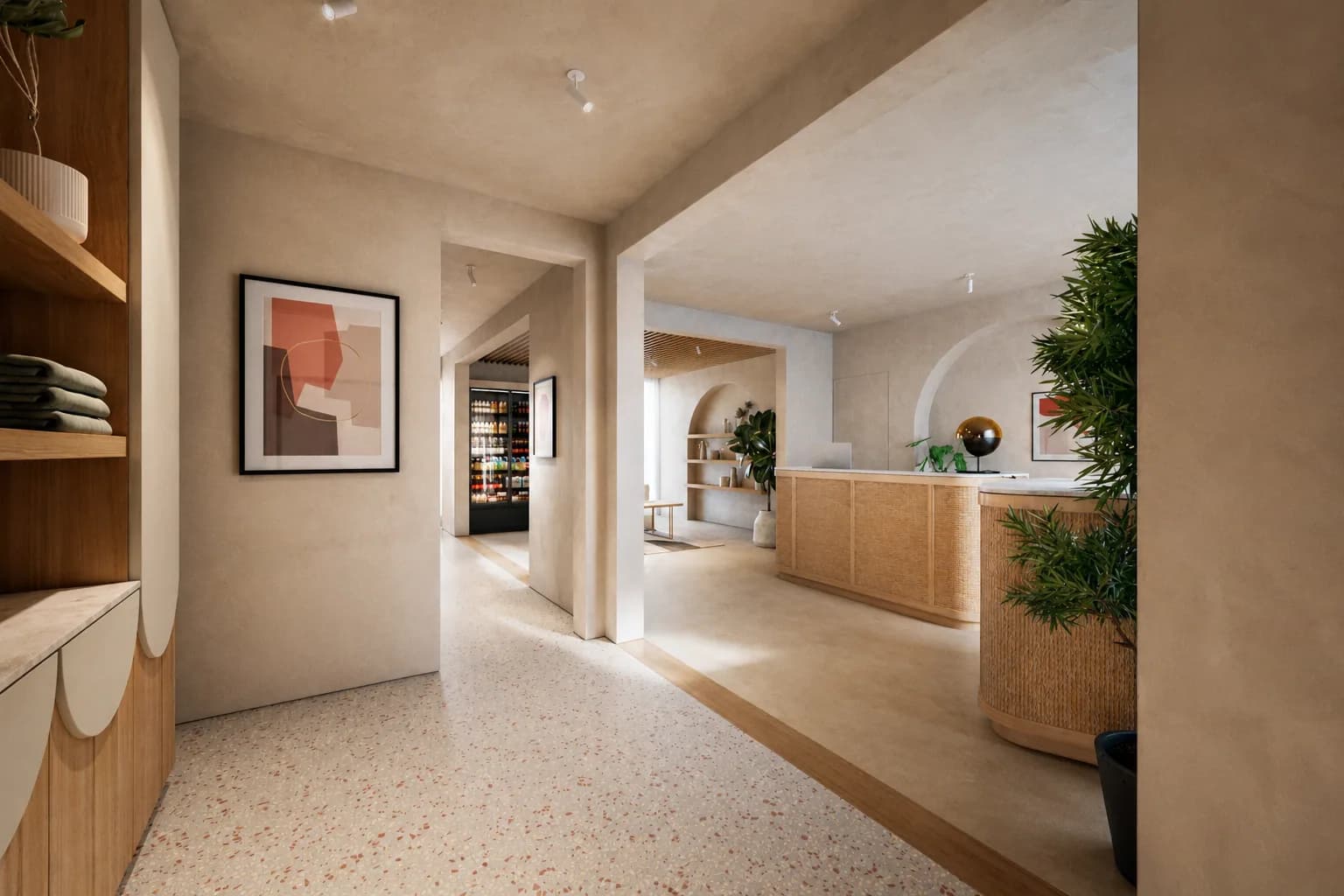
Commissioning an interior visualisation rarely starts with a budget. It starts with a design that has to come into view convincingly, for a client, an investor or the market. Yet process, input and cost are the first questions clients ask.
This article gives an honest overview: how the process runs and what determines the price.
The process in five steps
At Beyond3D an interior visualisation roughly runs in five steps.
1. Briefing and goal
We start with the question of what the imagery has to achieve. A visualisation for a design assessment calls for something different from an image for a sales pitch. That goal steers every choice that follows.
2. Input and preparation
We gather the source material: floor plan or 3D file, material choices, references. The more complete this is, the more efficient the process, more on that below.
3. Build-up and visual direction
The space is built up in 3D and we determine the camera positions, the lighting situation and the atmosphere. This is the moment the direction is fixed, comparable to the step from moodboard to render.
4. Render and review
The images are worked out and refined in one or more feedback rounds. Material, light and composition are adjusted until the image is right.
5. Delivery
The final images are delivered in the right format and resolution for the goal, print, web or presentation.
What input is needed?
The quality and speed of a visualisation depend strongly on the input. Useful to supply:
- a floor plan or, better still, a 3D file (SketchUp, CAD, Revit);
- the material and colour choices, or the direction of them;
- references or a moodboard for the desired atmosphere;
- relevant technical data such as ceiling heights and window positions;
- the goal of the images and where they will be used.
Not everything has to be complete. We often build along from concept, but then it is good to know that in advance, so the approach is tuned to it.
What determines the cost?
An interior visualisation is bespoke; a fixed price does not exist. The cost is determined by a recognisable set of factors:
- Number of images — one image or a series of an entire space.
- Complexity of the space — a clean room is something different from a detailed hospitality interior.
- Level of detail — how refined material, styling and dressing have to be.
- Number of lighting situations — the same space in day and evening is double the work on light.
- Quality of the input — a complete 3D file saves build-up time; loose sketches call for more.
- Still image or animation — a 3D animation is a different process from a still.
- Deadline and number of feedback rounds — tight schedules and extensive reviews weigh in.
A single atmospheric image of a defined space is in a different order from a full image series for a hospitality concept.
Lead time
The lead time also depends on scope. As an indication:
- a single image or a small series — usually 1 to 3 weeks;
- an extensive series or a complete project — several weeks, depending on the number of spaces and review rounds.
The biggest time saving is at the start: complete, clear input makes the whole process faster.
How to get a reliable estimate
The fastest route to a realistic price is a short briefing with the available source material. With insight into the scope, the number of images, the type of space, the level of detail and the planning, we give a well-founded project estimate.
Discuss your project and send along what you already have. The more concrete the starting point, the sharper the answer.
Joey Heynens · Beyond3D