Real estate
3D visualisation for new-build: selling before the first pile goes into the ground
New-build is sold on the basis of a promise. How 3D visualisation makes that promise tangible and speeds up the sale of homes.
Author
Joey Heynens
Published
10 May 2026
Category
Real estate
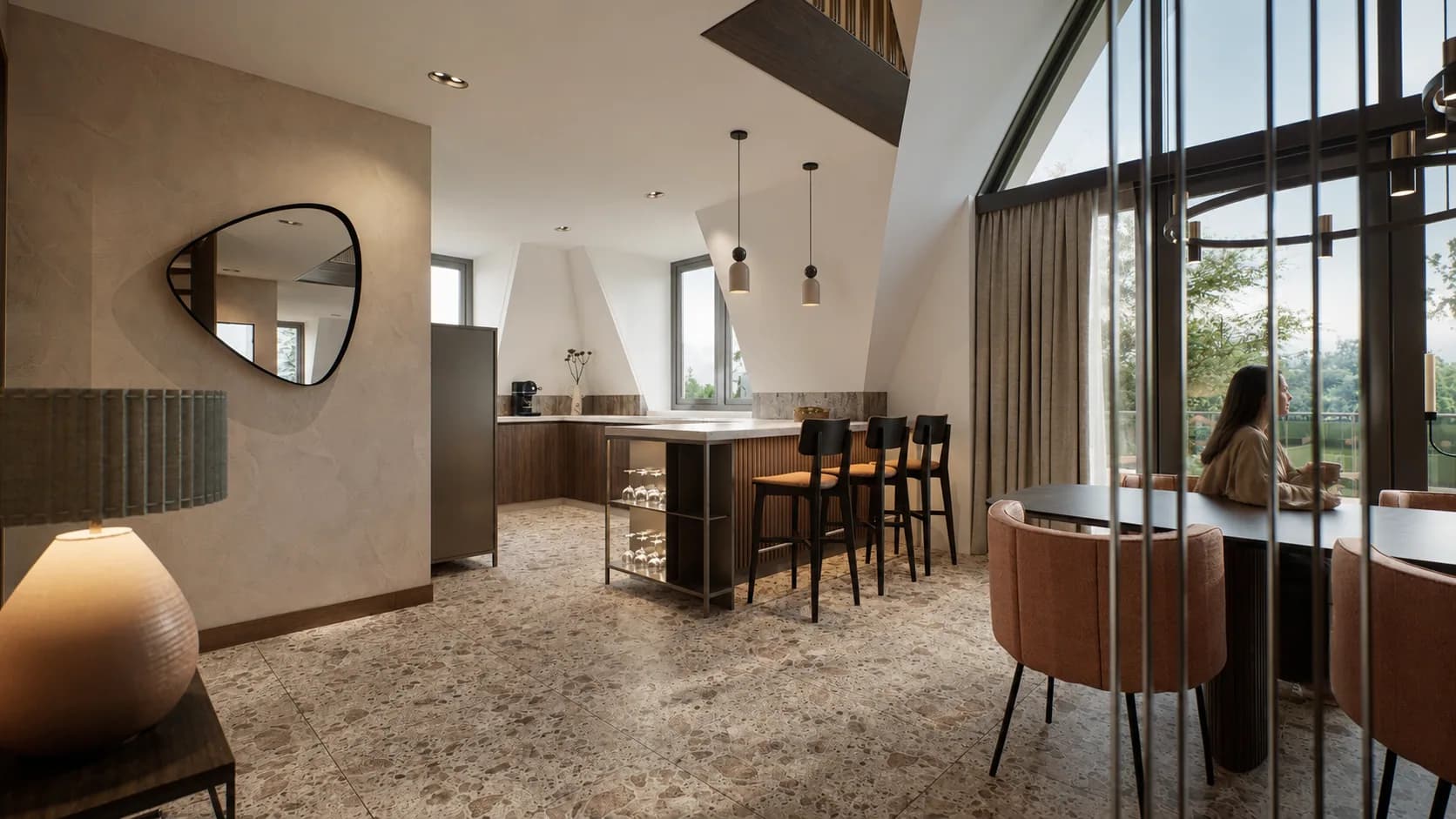
New-build is sold on a promise. A buyer chooses a home that only exists on paper, in a complex that is not yet built, in a neighbourhood that sometimes still has to come into being. The question for every developer is: how do you make that promise so concrete that a buyer says yes to it with confidence?
This article is about the role of 3D visualisation in selling new-build.
The problem of selling on paper
A floor plan is a professional document. For a developer or architect it is fully readable; for the average buyer it is not. A buyer sees lines and dimensions, but feels no space, no light, no life.
That difference costs sales speed. Doubt arises where imagination falls short. And in a sales process, doubt is the most expensive factor: it lengthens the timeline, weakens the price and increases the risk of drop-outs.
What 3D visualisation solves
A strong sales visualisation replaces imagination with certainty. The buyer does not see a drawing of a home, but the home itself:
- how the light falls through the space on an ordinary morning;
- what the view from the balcony really looks like;
- how the home feels as a place to live, not as square metres;
- how the complex and the neighbourhood together form an environment.
When a buyer sees that, the decision is no longer about a risk. It is about a choice.
Where visualisation makes the difference in the sales process
New-build sales have a number of moments where imagery makes the difference.
The sales brochure and website
This is the first contact. The images determine whether a potential buyer clicks through or drops out. They carry the first impression of the whole project.
The sales conversation
In conversation with an agent, imagery helps to answer questions concretely. A buyer who pictures the end result asks better questions and reaches a decision faster.
Differentiation between home types
A project often has multiple home types and price ranges. Visualisation makes the difference between those types tangible, so a buyer chooses the home that really suits them, instead of dropping out at doubt.
In the case for Bloem on Texel that is the starting point: not selling the floor plan, but the living.
Which images do you need for new-build sales?
That depends on the project, but a sales set often contains a combination of exterior images, interior images per home type and sometimes a bird's-eye view or animation. Which type of image serves which goal is explained in which real estate images do you need.
The timing of visualisation
Visualisation has the strongest effect when it is there at the sales launch. The images have to be ready before the brochure and the website go live, because that is the moment the first and most important impression is formed.
That means the image process has to be taken into the planning early, in parallel with working out the design. More on planning and costs in commissioning real estate visualisation.
Conclusion
Selling new-build is conveying a promise convincingly. 3D visualisation is the instrument that makes that promise tangible: it turns a drawing into a home someone can see themselves living in.
Do you have a new-build project that needs to come into view convincingly? Discuss your project and we will look at what the sale needs.
Joey Heynens · Beyond3D