Stage visuals
Festival visuals: from main stage LED to immersive experience
Festival visuals have to give energy, be recognisable and run in sync with music and light. How imagery contributes to a festival's identity, on the main stage and beyond.
Author
Joey Heynens
Published
14 April 2026
Category
Stage visuals
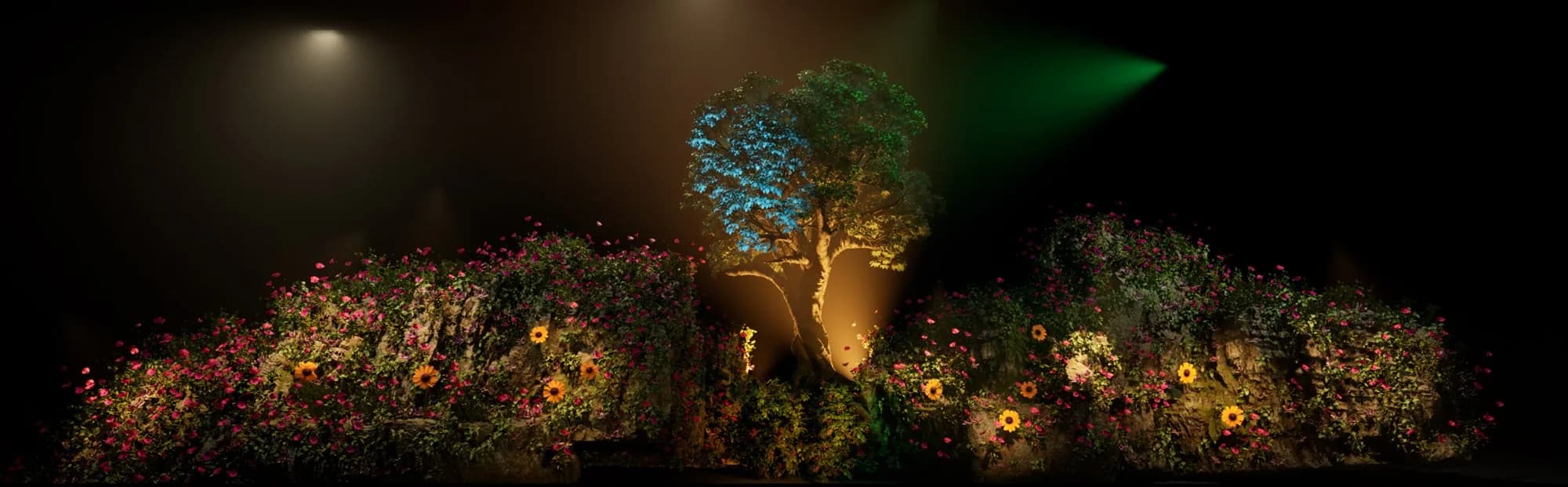
Festival visuals are the images that give a festival its face, on the main stage, on the stages around it and in the spaces in between. Unlike theatre, this is not about a story unfolding, but about energy, recognisability and synchronisation with music and light.
This article is about what sets festival visuals apart and how they contribute to the experience of an event.
What makes festival visuals different
Stage visuals for a musical follow a script. Festival visuals follow a feeling. That difference shapes almost every choice:
- Energy over narrative — the imagery has to carry the intensity of the moment, not tell a plot.
- Repeatability — content often runs for hours, in changing sets and with different artists.
- Synchronisation — image, light and sound have to feel like one whole, even though they are driven by different teams.
- Identity — a festival has a brand. The visuals are one of its strongest carriers.
The main stage as visual heart
The main stage is where a festival's visual identity becomes most visible. The LED canvas is large, the audience is large, and the imagery has to work from a great distance.
That places demands on the content:
Readability at scale
Imagery that is beautiful up close can collapse into noise at a hundred metres. Festival visuals for a main stage work with clear shapes, strong contrast and movement that is also legible from afar.
Set integration
Increasingly the LED canvas is integrated into a physical stage set, a structure, an object, a shape. The content has to reinforce that shape. At the main stage of Mysteryland, the imagery becomes part of the total stage architecture.
Room for light and pyro
Just as in theatre, the image content shares the space with other disciplines. A main stage show lives on light, lasers and effects. The visuals leave room for that, they are a layer in the whole, not the entire show.
Beyond the main stage: immersive experience
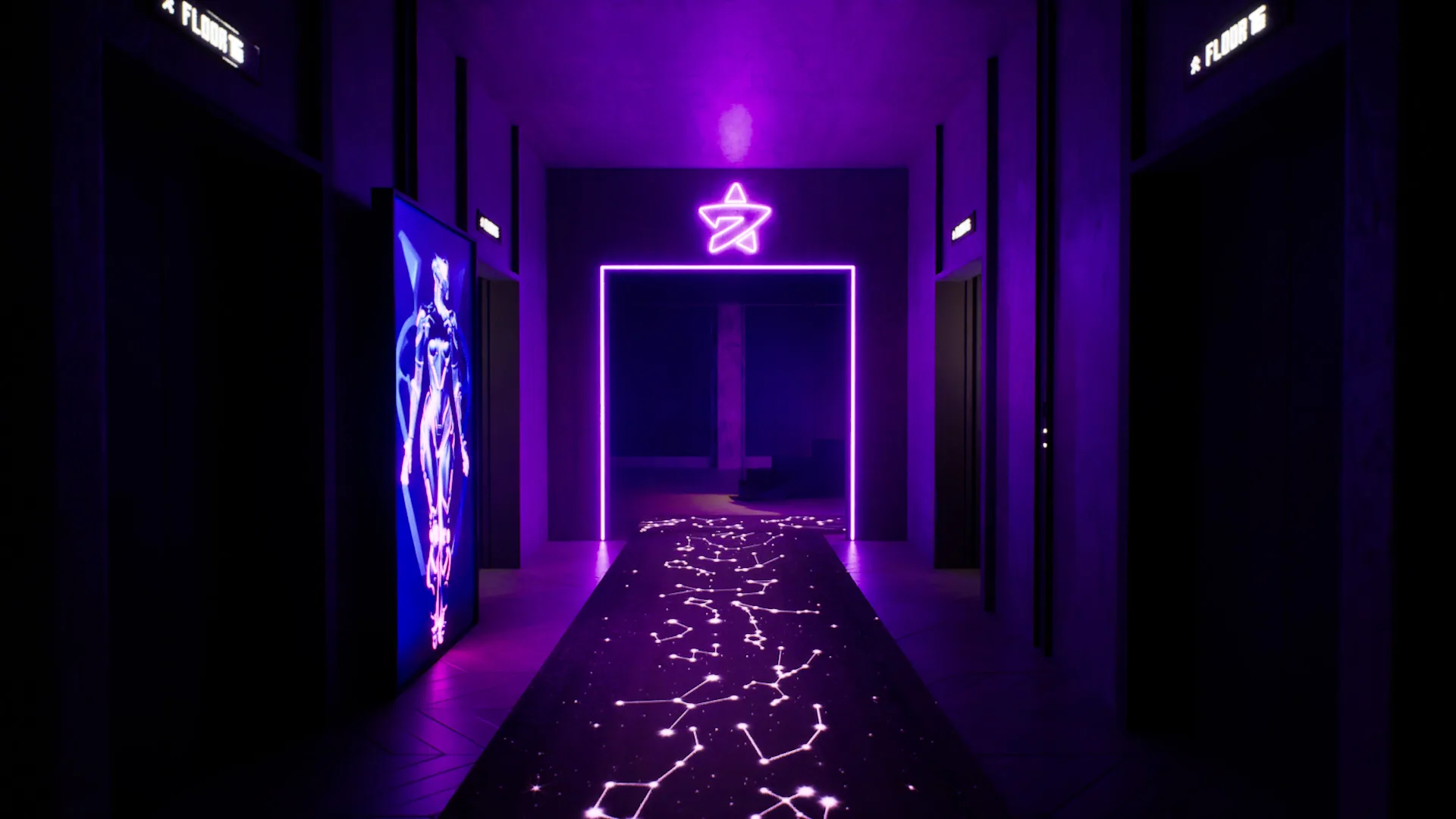
Festivals are no longer only stages. The space between the stages, the paths, the squares, the resting places, is increasingly designed itself. There, festival imagery shifts from watching a stage to being in an environment.
That touches on immersive 3D experiences: imagery that fills an entire space, that surrounds the visitor and sometimes responds to their presence. For a festival this is a way to extend the identity into every corner of the site.
How festival visuals come about
The approach differs per festival, but roughly follows this line:
- Brand and theme — what is the identity of this edition, which feeling should the imagery carry.
- Stage and technology — the shape of the LED canvas and the technical setup determine the canvas.
- Visual direction — style, colour palette, movement and the degree of abstraction.
- Content production — the 3D image worlds are built and animated, often in several loops and variants.
- Alignment with light and sound — the imagery is made part of the total show design.
Why festival visuals are an investment
A festival competes on experience. The line-up draws visitors, but the visual world determines how the festival is remembered, and how it is shared. Strong festival visuals are therefore not only set dressing, but part of the brand.
Want to explore the visual side for an upcoming edition? Discuss your project and we will look together at what the festival needs.
Joey Heynens · Beyond3D