Stage visuals
What are stage visuals? A guide to LED content for theatre and live shows
Stage visuals are the moving images that give a live production its visual world. A clear explanation of what they do, which forms exist and when to use them.
Author
Joey Heynens
Published
12 May 2026
Category
Stage visuals
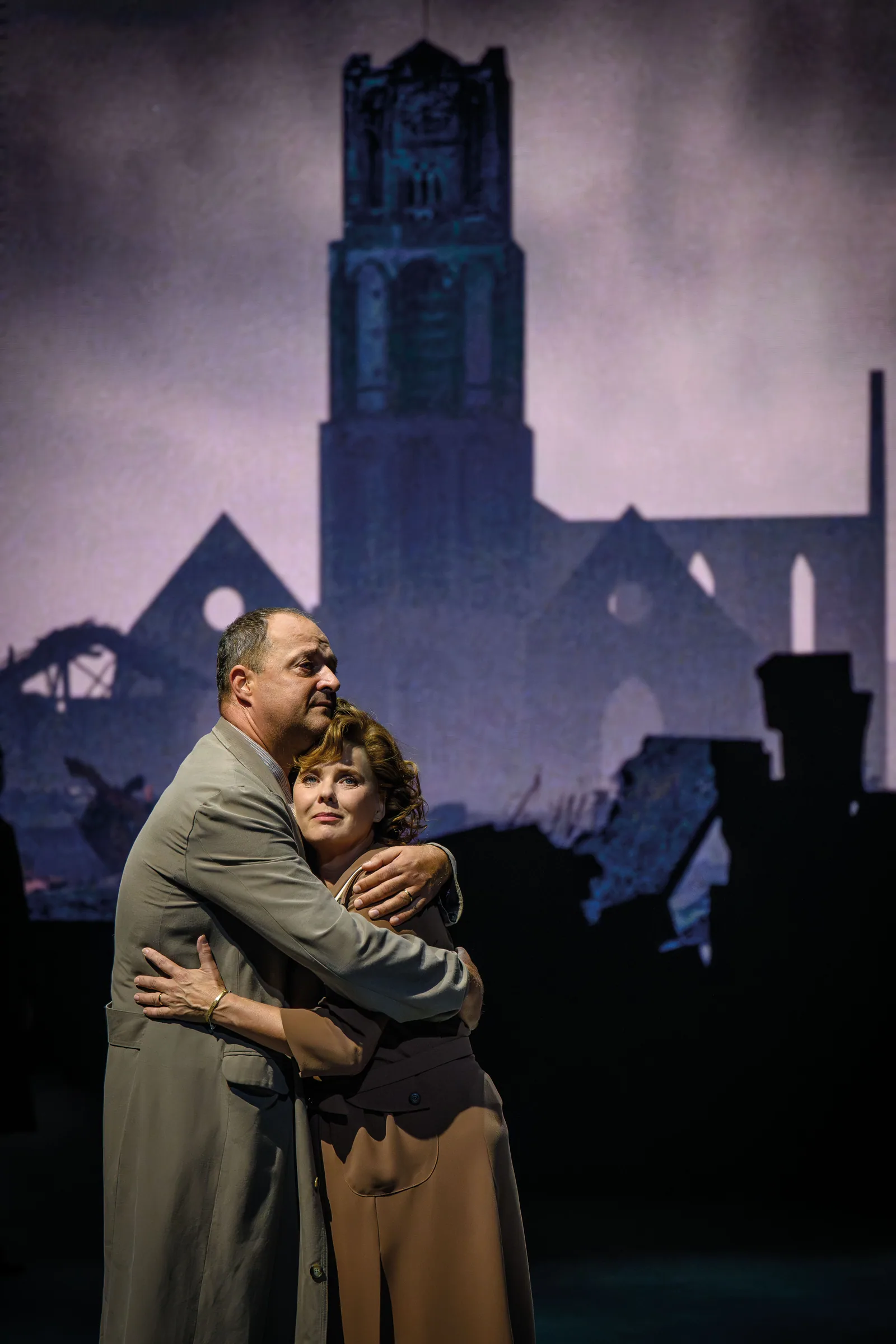
Stage visuals are the moving or still images that appear on LED screens, projection or set panels during a live production. They form the visual world behind and around the performers, from a musical set to the main stage of a festival. Good stage visuals are not decoration: they tell the story too, steer attention and give a production a scale that physical set alone cannot reach.
In this article we explain what stage visuals do, which forms exist and when a production benefits from them.
What stage visuals do in a production
An empty LED screen is a technical means. Stage visuals turn it into a dramaturgical means. In practice they have four functions at once:
- Building a world — a scene gains a place, a time and an atmosphere without the set having to physically change.
- Steering attention — movement, depth and light in the image guide the audience's gaze to the right moment.
- Giving scale — a horizon, a city or a sky reaches further than any built set can.
- Carrying rhythm — a scene transition feels like a camera move rather than a change.
The difference between visuals that work and visuals that distract almost always lies in that last function: timing. Imagery that is detached from the direction pulls attention away from the stage. Imagery that sits on the cue reinforces the performance.
Which types of stage visuals are there?
The term stage visuals covers several applications. The most important:
LED backdrop content
Imagery for the large screens behind the stage, often the main means in modern theatre and musical productions. The content is built up per scene and synchronised with script, light and set.
Moving and mobile screens
More and more productions use screens that move themselves. The content then not only has to match the scene, but also the physical movement of the screen, with perspective and depth becoming part of the choreography.
Festival and stage visuals
For festivals and concerts it is about energy, recognisability and synchronisation with music and light. We wrote a separate article about it: festival visuals, from main stage to immersive experience.
Immersive and interactive content
Imagery that fills an entire space or that responds to the visitor. This touches on immersive 3D experiences and virtual production.
How stage visuals relate to set, light and direction
Stage visuals never stand on their own. They are developed within the triangle of set, light and direction:
- Set determines where the screen stands, how large it is and how the image physically connects to the set.
- Light determines how bright and high-contrast the image may be, an overly busy image fights with the lighting designer.
- Direction determines the timing: when a movement comes in, how long a transition lasts, where the gaze should go.
That is why good work does not start in the software, but in the conversation with the creative team. The visuals are tuned to choices already made, or actually help to sharpen those choices.
When do you choose stage visuals?
Stage visuals are the right choice when:
- a production has to show multiple locations or worlds without endless set changes;
- the scale of the story is larger than a physical set can handle;
- imagery and movement have a dramatic function, not only a decorative one;
- the production travels and the set has to stay light and flexible.
For an intimate, static performance with one location, classic set design can actually be stronger. The question is always: what does this story need?
Frequently asked questions about stage visuals
What is the difference between stage visuals and projection?
Projection is a technique for showing imagery; stage visuals are the content. That content can be shown on LED screens, via projection or on set panels. LED is now the most used in large productions because of brightness and contrast.
Do you make the content or also the technology?
Beyond3D develops the visual content, the image world per scene. The technical installation (screens, media servers) is usually handled by the production's technical partner. We deliver in the right format and align with their setup.
How far in advance does content have to be ready?
Ideally the content is ready for the technical rehearsals, so that rehearsals can take place with real imagery. For planning: see stage visuals services, process and costs.
For which productions do you make stage visuals?
From large spectacle musicals to festivals and theatre. One example is the Studio 100 musical 40-45, with image content for moving LED screens.
Stage visuals are at their best when no one notices them as a separate element, when the imagery is simply part of the performance. That calls for content that follows the direction rather than playing over it.
Joey Heynens · Beyond3D