Stage visuals
Commissioning stage visuals: the process, the planning and the cost
What is involved in commissioning stage visuals? An honest overview of the process, the lead time, the input required and the factors that determine the price.
Author
Joey Heynens
Published
31 March 2026
Category
Stage visuals
Commissioning stage visuals rarely starts with a budget and a deadline. It starts with a production that needs a visual world. Yet process, planning and cost are exactly the questions clients want answered first.
This article gives an honest overview, without a fixed price list, because for bespoke work that does not exist, but with the factors that make the difference.
The process in five phases
At Beyond3D, making stage visuals roughly runs in five phases.
1. Briefing and goal
We start with the question behind the question. What should the imagery achieve? Which scenes or moments call for visuals? Here the script, directing vision, set design and lighting plan come to the table. The more complete this picture, the sharper the estimate.
2. Concept and visual direction
For each scene or moment we determine an image world: style, colour, camera, movement, degree of abstraction. This is the phase in which choices are made, and in which we align with the creative team.
3. 3D production
The image worlds are built and animated. Perspective and depth are tuned to the screen setup. This is usually the longest phase.
4. Rehearsing with imagery
Content is tested during technical rehearsals. Only with real imagery on the real screen does it become clear whether timing and cues match.
5. Refinement and delivery
Based on the rehearsals the imagery is adjusted and delivered in the right format to the technical partner.
Lead time: what does it depend on?
A reliable lead time depends on scope, not on a fixed figure. As an indication:
- A few scenes or a defined set of visuals — a few weeks.
- A full production with a lot of scene content — several months, often in parallel with the wider production schedule.
The most important planning rule: the content has to be ready before the technical rehearsals. Imagery that only arrives during the final rehearsals can no longer be properly set up.
What input is needed?
The more complete the input, the more efficient the process. Useful to supply:
- the script and/or a scene overview;
- the directing vision or a description of the intended feeling per scene;
- the set design and the technical specifications of the screens;
- the lighting plan, if available;
- references and moodboards.
Not everything has to be complete at the start. We often build along from concept, but then it is good to know that in advance, so the planning is set up for it.
What determines the cost?
Stage visuals are bespoke. A fixed price does not exist, but the price is determined by a recognisable set of factors:
- Amount of content — the number of scenes, moments or loops that need imagery.
- Complexity of the image worlds — an abstract movement is something different from a detailed, photorealistic environment.
- Moving or fixed screens — mobile screens call for extra work on perspective and synchronisation.
- Degree of animation — still imagery, subtle movement or full cinematic animation.
- Number of feedback rounds and deadline — tight deadlines and extensive review processes weigh in.
- Rehearsal support — presence and adjustment during technical rehearsals.
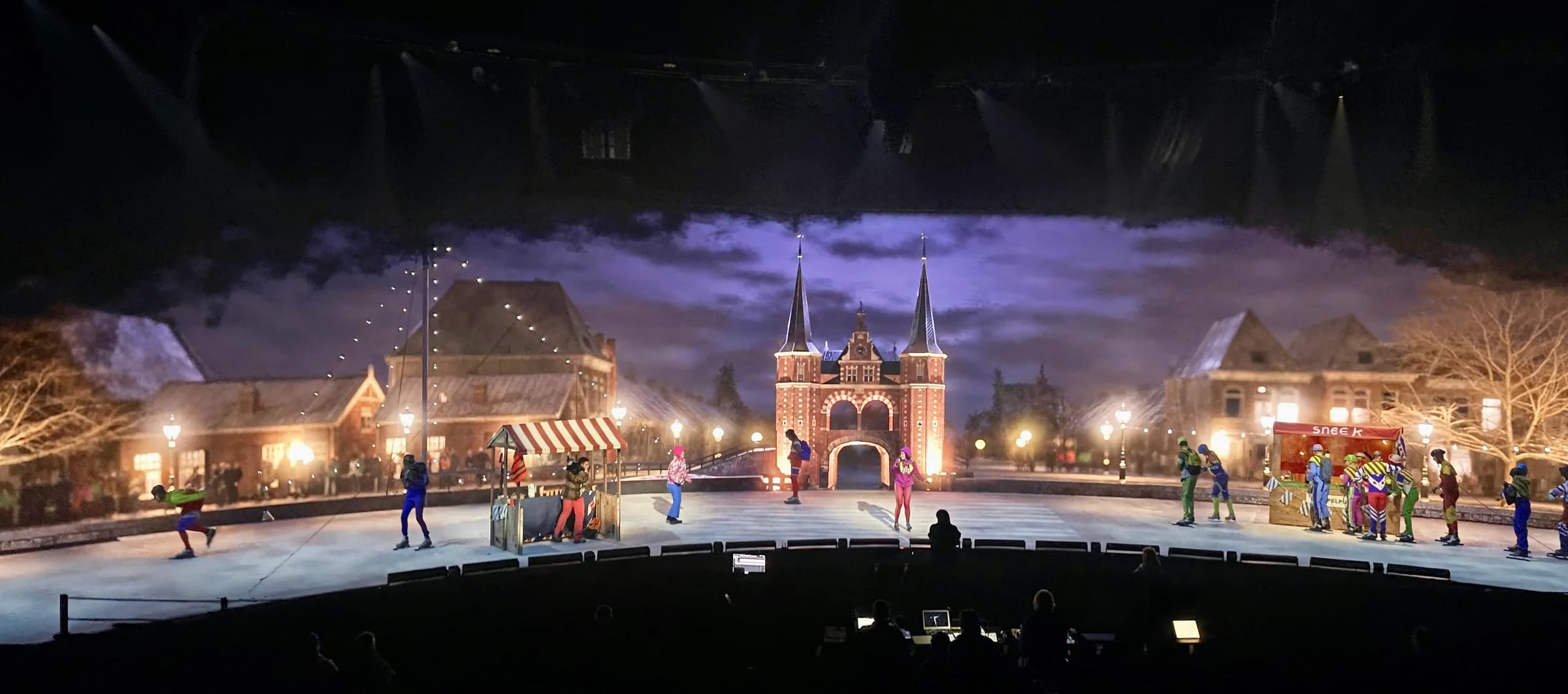
A production with a handful of abstract backgrounds is in a completely different order from a spectacle musical with dozens of unique, moving image worlds, like the Studio 100 musical 40-45.
How to get a reliable estimate
The fastest route to a realistic estimate is a conversation with a concise briefing alongside it. With insight into the scope, the number of scenes, the type of imagery, the screen setup and the planning, we can give a well-founded project estimate.
Discuss your project and send along what you already have. The more concrete the starting point, the sharper the answer.
Joey Heynens · Beyond3D