Stage visuals
Virtual production or LED backdrop content: which suits your production?
Virtual production and classic LED backdrop content both use large screens, but they solve different problems. A clear comparison.
Author
Joey Heynens
Published
17 March 2026
Category
Stage visuals
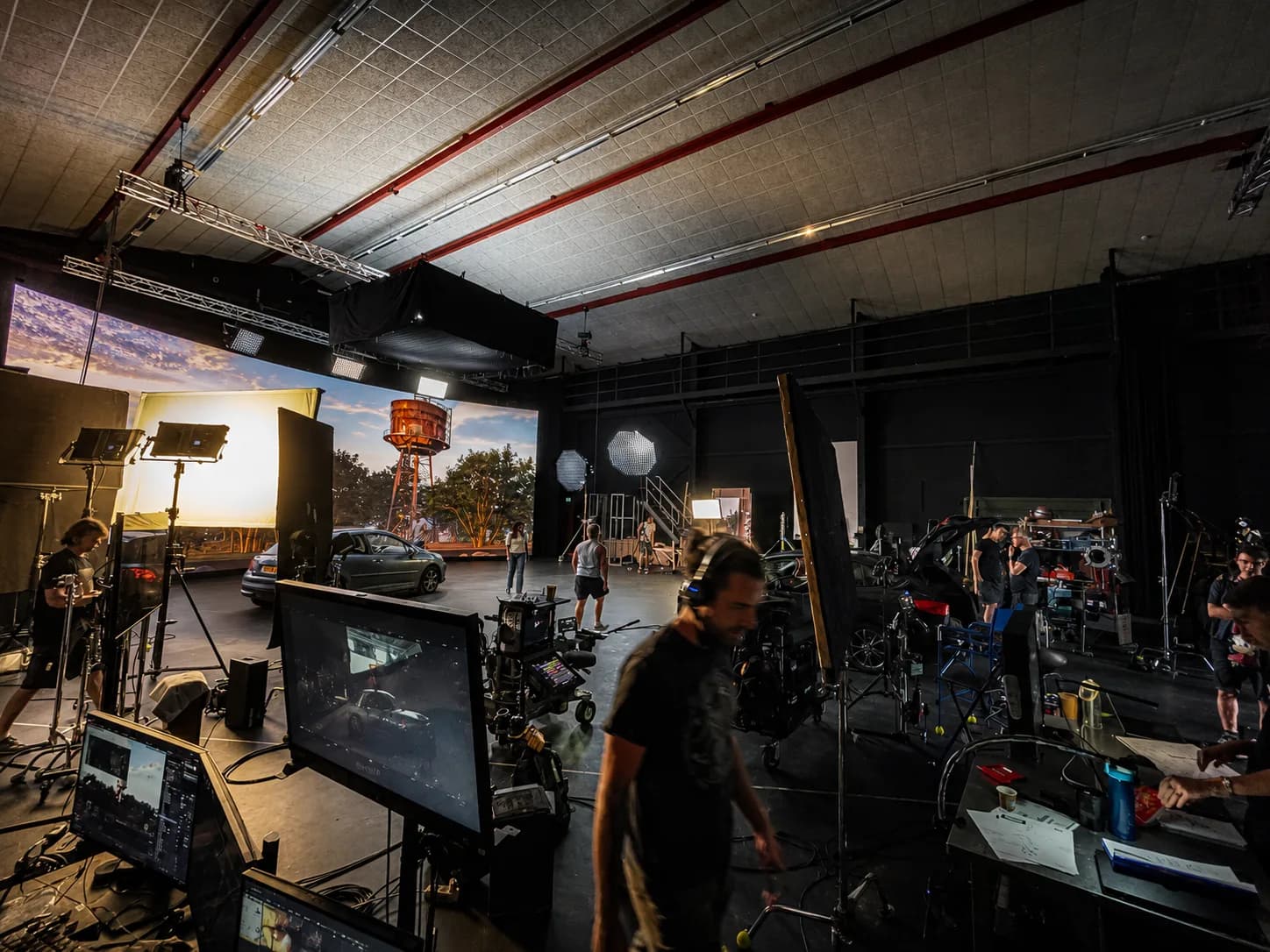
Virtual production and classic LED backdrop content look alike: both show 3D imagery on large LED screens. But they solve different problems. The difference is not in the screen, it is in the question of whether the image responds to a camera.
This article sets the two side by side, so you know which approach suits your production.
The short definition
LED backdrop content is pre-made imagery played back on a screen. The audience, or the camera, looks at it as at a painted cloth that moves. This is the basis of most stage visuals in theatre, musical and festival.
Virtual production is imagery calculated in real time that moves with the camera. When the camera turns, the perspective in the LED volume turns along, as if there were a real space behind the actor. This is mainly used for film and high-end video.
The core difference: does the image respond to the camera?
This is the question that determines the choice.
- With LED backdrop content the perspective is fixed. The image is beautiful from one intended viewing direction, that of the audience. A film camera moving diagonally past it would break the illusion.
- With virtual production the perspective is dynamic. A tracking system follows the camera and the 3D environment is recalculated every frame, so that parallax and depth always match.
That also immediately makes clear when you choose which.
When do you choose LED backdrop content?
For live productions with an audience: theatre, musicals, concerts, festivals, events. The audience sits in a fixed place and looks from a fixed direction. The imagery does not have to respond to a camera, it has to match set, light and direction.
LED backdrop content is then the right and efficient choice. It is predictable, it can be set up during rehearsals and it does not need a real-time system running. For productions like the Studio 100 musical 40-45, this is the approach.
When do you choose virtual production?
For shoots with a camera: film, commercials, high-end video, presentation content. When the camera has to move through the scene and the background has to move along believably, virtual production is the solution.
The advantages over a green screen:
- the actor stands in a space they can also see, lighting and reflections match immediately;
- the director already sees the final scene on set, not only in post-production;
- locations that do not exist or are unreachable become tangible.
A comparison in brief
| LED backdrop content | Virtual production | |
|---|---|---|
| Perspective | Fixed, aimed at the audience | Dynamic, follows the camera |
| Main application | Live shows with an audience | Film and video shoots |
| Real time needed? | No, imagery is played back | Yes, imagery is calculated live |
| Aligned with | Set, light, direction, timing | Camera, lens, tracking |
| Strongest side | Scale and atmosphere for an audience | Believable depth for a camera |
Often it is not either/or
In practice the worlds flow into each other. A production can use virtual production for shoots and LED backdrop content for the live show. And the 3D skills underneath are largely the same: building image worlds that are right in perspective, light and depth.
That also touches on immersive 3D experiences, imagery that fills a space and sometimes responds to the visitor. The common denominator is always: 3D content that has to work in a physical space.
How to make the right choice
Do not start with the technology, but with the question: who is watching, and from which direction?
- Is an audience watching from a fixed place? Then LED backdrop content is almost always the right choice.
- Is a camera watching that moves? Then virtual production is worth considering.
Unsure which approach suits your production? Discuss your project and we will look together at what the imagery has to do, and choose the technology that fits.
Joey Heynens · Beyond3D